Thursday, October 25, 2012

Totoralillo

Last Saturday I ate a hurried lunch at home before hurrying to el centro. I was on a mission. Will, Maca, Lucas and I were going to the beach, which could only mean one thing: I needed a kite. During las Fiestras Patrias volantines are easy to find, but I had to ask  around in a couple of shops before finding one that carried kites.

I then headed to the bus terminal to meet up with the others. We waited for a bus to come that was headed the way we were going and hopped on. The bus ride was about forty-five minutes - 25 minutes to Coquimbo followed by 20 minutes watching the rugged coastline whiz past.

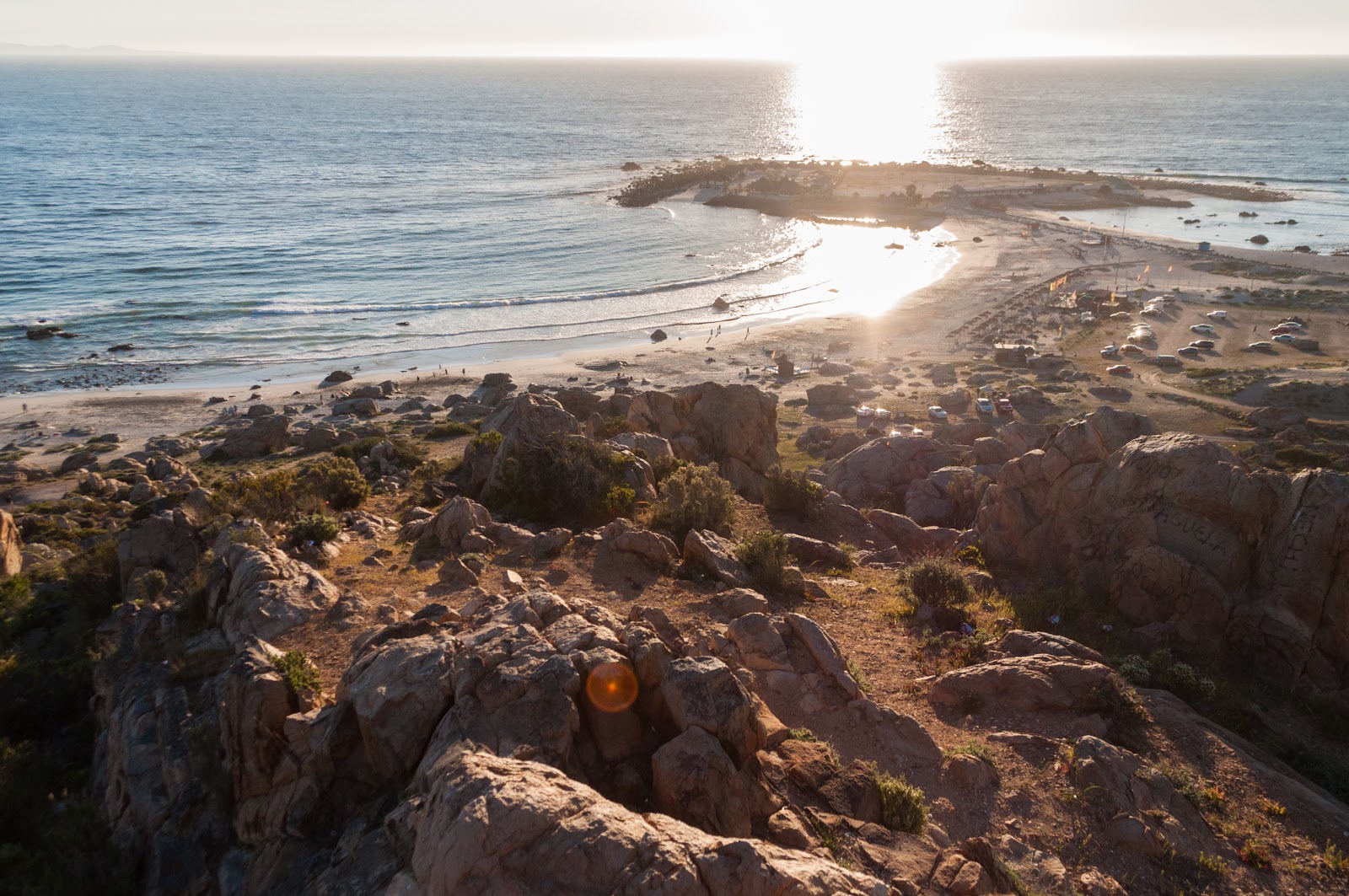
The bus dropped us off on the side of the highway and for over half an hour we walked down a windy road past the town of Totoralillo to the beach. The bad news: I discovered that my camera was basically out of batteries. (I took a grand total of 3 pictures on my camera during the trip.) Without further ado, I give you:

Totoralillo!


It was a perfect day for the beach. Paradoxically, there were amazing cloud banks covering the sky but it always seemed to be sunny.  I didn't swim, since the water was quite cold, but Lucas, Maca, and I convinced Will by offering him 1000, 500, and 500 CLP respectively (a total of ~four dollars!). He had to stay in the water for a full minute, fully submerged except for his head. Yikes.

There was a beautiful rocky hill abutting the beach, which tempted me no end. It wasn't very big so I scrambled up and within 10 minutes was enjoying the vista from the cima (top).  It was windy and I felt like this (minus all the pink and the leaves) :


I went back down to the beach and Will and I did some crossword puzzles (still addicted) before having a frisbee catch with Lucas. 
Soon enough I declared it to be kite time, so this time Will joined me and we clambered up the boulder-strewn hill with the volantín. The wind pattern kept blowing the kite into the side of the hill, which meant that we didn't have much success, but it was a lot of fun nonetheless.

(The next four photos are Will's, whose camera was functioning properly. He's a great photographer, as you can tell. Thanks, Will!)

I wanted to feel more like Pocahontas so I unbraided my hair.
Unsure why my expression is so pained.


After a few successes and many failures with the kite, we headed back down to the beach and packed our things up. The sun was setting, producing a beautiful array of colors in the sky and reflected in the water. Being on the Pacific is absolutely amazing - before coming to Chile I had never really experienced an ocean sunset before.  Though it's now a common sight for me, it hasn't lost any of its wonder for me.

My battery died again just when the sun dipped below the horizon.
It was about 8:15, and since it was a 45 minute walk back up to the highway we had to hurry to make sure we'd make the last bus that would pass by (at about 9pm). On the walk up, Lucas asked if we'd ever hitch-hiked (hacer el dedo). Will and I hadn't, but he and Maca had; it's a lot safer and more common in Chile.

With that in mind, we all stuck our thumbs out at the next car that passed by that might be able to fit all of us. An middle-aged man and his young son kindly picked us up, and with all four of us squished into the back seat he dropped us off at the highway. We knew we'd probably be waiting a while for the bus to come, so we decided to try hitchhiking again. We were lucky! Within five minutes Lucas was in the front of a pick-up with Maca, Will and I in the back, headed to Coquimbo. From Coquimbo, Will and I took a micro back to La Serena and were back in our homes by 10pm. An excellent day.


(The kite is furled in my room, waiting for its next beach expedition.)

Neglect

I've been horrible about my blog - I'm sorry! I have, however, been adding photos to facebook so that is one way to keep track of some of my Chilean adventures.

More posts coming this week, I promise!

Thursday, October 11, 2012

viaje este finde

Just a note to my devoted blog readers:

I felt guilty about not posting when I went to Algarrobo in advance because I didn't post for a while... So I'm letting you know that I'm leaving tomorrow to go to Salamanca until Monday night!

Posts will continue after.

marcha

Not so surprising: more student protests.

Last week the student federation requested another "hora protegida" in which there are no university classes. Today from 11:30 - 2:30 all classes were cancelled to allow for students to participate in a marcha.

Why? you ask.

Well, this is why:
Education should be a right.
[sidewalk at the bottom of Campus Andres Bello.]

At 11:15 I left Análisis Numérico class and headed to the cafeteria/dining hall of Campus Isabel Bongard - just below the hill of Campus Andres Bello. This campus borders one of the main roads of La Serena, which is where the march passed by around 1:45pm. There were carabineros (policemen) stationed along the road, which meant that some were right outside the fence of the university.

((I suppose that bears mentioning - each campus is fenced in and they are locked at night, which is different from the US.))

As the mass of people passed by, I was surprised at how calm and silent it seemed. The peace was quickly shattered when 5-10 students with masks on or hoods up ran across the Isabel Bongard campus and started throwing stones and insults at the carabineros. On the upper level of the cafeteria on campus, necks craned to watch the action, and other students joined in on the shouting. A campus security guard who had been stationed near the fence slowly ambled off to the center of campus, away from the encapuchados (masked students). I took that to mean he was giving tacit approval to the cause that the students were protesting.

For a couple minutes the carabineros tolerated it, but they soon began targeting the stone-throwers with a fire hose. Most got out of range by running towards the center of campus before the policemen could hit them, but a few ended up hiding behind trees until they could run to safety. Crowds formed along the fringe of the range of the fire hose, and milled around even after the encapuchados scampered away to blend back in with the rest of the students and the carabineros stopped the jet of water.

About 15 minutes after this, I had to go to my 2:30 class in Campus Andres Bello, so I went to leave campus Isabel Bongard... only to find that the gate was locked. It wasn't clear what the reason for this was - presumably to minimize confrontation between policemen and students (on campus) during the march. More pessimistically, it could be to prevent students from easily reentering campus if the march got violent. Without an easy means to escape, the marchers would be trapped in the streets at the mercy of the carabineros. Unfortunately, based on what I've seen and heard in Chile regarding education protests, I find that likely.

There was a small crowd of students waiting for someone to unlock the door, but to no avail. All was quiet, the march had dispersed, and the hora protegida was finished, so we expected it to be open by this point. After a few minutes of waiting, someone came to unlock it but brought the wrong keys for the padlock. He told students to go around to the other entrance, which was open. Most students opted to walk around, but I was already running late to class so I opted to join the few students who decided to climb and jump down from the 7 or 8 foot fence.

agujas y medicina china

My semester-long project for Educación Ambiental is to design and construct a purificador de agua - a water purifying system - to be used as a class project in local high schools. First, though, we had to make sure that our design actually worked before we implement it in a high school. Camila, a friend from class and in my group, invited me over to her house in Valle del Elqui (about 30 minutes away) last Saturday to work on the project.

More of the incredible Chilean kindness: Cami invited me to go to Pisco Elqui (a part of Valle del Elqui further away) with her and her friends before I leave Chile, her parents invited me to stay at the house anytime (and offered to invite Cami's friends over to have a bonfire) and to go horseback riding in a more remote location in the Valle.

Cami's mom, Brunilda, studied and practices Chinese medicine and acupuncture. She saw that I had dilated pupils (a constant issue. people usually think I'm high) and bad complexion and immediately diagnosed me with an overactive liver. Clearly. Then, she offered to give me acupuncture. I have a lot of trouble saying "no," so I didn't mention the fact that I'm scared of agujas (needles)...  and thus the idea of acupuncture really freaks me out. I also assumed that it was an offer for another time, and hoped maybe she'd forget about it. So, I said that would be fine with me.

After a delicious lunch, Cami and I worked on building our water purifier, which to our relief worked pretty well. To my surprise, Cami's mom then brought me to her office for an acupuncture session. I stuck my tongue out for inspection and took my pulse on both wrists at various finger pressures. We went over my medical history, and then the actual process began. She cleaned the spots where she would put the needles, then put them in.

She probably discovered my fear of needles when I cringed each time she inserted a needle into my skin. The first four, which were in my feet, did hurt a bit. Only two of the other hurt as well, but it was mostly just an irrational reaction. By the end, there were two needles in my feet, one by each ankle, two in each knee, one in each wrist, and three on my head (!!!). Throughout this process, she was talking to me, and came to the conclusion that I think too much, which probably gives me stress and the resultant hormonal unbalance negatively affects my liver.

Brunilda put calming music on and turned the lights off and then I was on my own to relax/sleep for 30 minutes or so. By the time she came back in the room, I was incredibly relaxed (though I hadn't slept). Could have been the acupuncture, or it could have been lying down with meditative music...

Brunilda proceeded to slowly remove the needles one by one. I discovered that having a needle being taken out from just above the midpoint between your eyes feels even weirder than putting one in. She then took out a cream that she gently started to apply to my stomach (well, above my liver, really). The cream's base is ceniza (ashes), presumably thousands of years old, from a volcano in Chillán (located in Southern Chile). The volcán is known for its healing properties throughout the alternative medicinal world. It dried as she began applying the same lotion to my face. After a few minutes she removed both with cold water. She felt around where my liver is to see if it had cooled down, and was very satisfied with its lowered temperature.

I switched to lying face down and received a superb neck and back massage for 5 minutes or so. After that, it was over! Brunilda gave me tips on foods and drinks to eat (bananas, for example) and to avoid (distilled alcoholic beverages), as well as some advice about other aspects of my life that might put my liver into hyperdrive - thinking too much and getting too much sunlight are two that I remember.

I am generally pretty skeptical about alternative medicine, which I of course refrained from mentioning. However, I can't deny that I left feeling incredibly refreshed and relaxed. I do also have great faith in the placebo effect, which may have played a part. I think it would take a few sessions of acupuncture at least to have any true effect, so I'm withholding final judgement until some later point in my life.

Based on this one session, though, I would recommend it!

Monday, October 8, 2012

Temblores


For some reason I was still up at 2:20am last night, which usually would bum me out given that I had to wake up before 7am today. However, being awake meant that I felt my first temblor (tremor - small earthquake) in Chile. At 2:22am the house shook slightly for a few seconds, which admittedly felt like a fair amount longer. It took me a second to realize what was happening, then all the dogs started barking. There was no damage at all, since it was about a magnitude 4, thankfully.

Here's the link to some technical information about the tremor!

I think the best part is that I fell asleep right after that, dogs and all. I suppose I just hadn't wanted to miss out on this Chilean rite of passage.

Edit!
Of course, less than half an hour after I post this, there's another temblor. This one was 5.2 magnitude according to this report, but still just some house-shaking.

Here's more info on magnitudes of earthquakes! Trusty wikipedia.

Sunday, September 30, 2012

la protesta estudiantil


Dissatisfaction with the education system continues. For those who don't know, a year and a half ago there was a 6-month strike in the Chilean universities, and the unrest hasn't disappeared. Protests are countrywide, with the biggest obviously in Santiago, sometimes involving hundreds of thousands of participants. As I've already mentioned, this semester at ULS there was already a one day paro (strike), a 6-day toma (take-over), and many student asambleas (assemblies). 

Last Thursday, September 27th, the block of 11:30 classes was cancelled throughout ULS because the Federation of Students of ULS  had petitioned eloquently for permission for a student marcha (march) in the center of La Serena. Similar marches occurred throughout the country, if I'm not mistaken. To elaborate on this I will give some background information about the educational unrest.

Students believe that Piñera's policies to channel money into the Chilean high education system have not gone far enough, calling instead for systemic changes that would make education less privatized and accessible to all young Chileans, regardless of their resources. Public institutions in Chile charge as much as privatized ones, which causes outrage in Chilean students when they compare Chile's education system to some of its Latin-American counterparts. Argentina, for example, offers tuition-free higher education (post-graduate education studies excepted). Students in high school, too, protest the education system; in 2011 there were hundreds of high school tomas.

Student protests take the form of marches, meetings, takeovers, strikes, and more - sometimes violent. However, very few changes have been enacted by Piñera's administration. Instead, one of the great achievements of the student movement has been to drastically lower Piñera's approval rating, which was previously at a high following the mining rescue in 2010. Though it is currently at 36%*, some sources say that it was as low as 22% at the height of the student protests. In contrast, the student movement, at its height, had an public approval rating of 72% (and I can't find a current statistic).


This is a good article for some background information, although most of it isn't relevant to my general topic as it mainly covers the leadership of the student movement. So, for those who don't want to read the whole article (it's really long...), I picked out the salient quotes:


  • "A university education in Chile is proportionally the world’s most expensive: $3,400 a year in a country where the average annual salary is about $8,500."
  • "Hoping to erode popular support for the students, government spokesmen and conservative media portrayed the protesters as lawless radicals. Most notorious among them were the encapuchados, who wore scarves around their faces and hurled rocks and Molotov cocktails at the police. Students insisted that most encapuchados were from outside the movement and that at least some were infiltrators, planted to incite police counterattacks."
  • “'Because in Chile it’s the fathers who are the nihilists, the suicides, the silent ones, the frustrated, and their children the reformers, the realists, the strategists.'"
  • "... the new student leadership has to avoid allowing the encapuchados, who feed government accusations that the movement is increasingly violent, to dominate the demonstrations"


And now back to La Serena. The time period of 11:15-2:30 was reserved for the march. My 9:45 class happens to be in the Ingeniería (Engineering) campus, which is located close to where the march would be. As I headed out of it at 11:15, I ran into a few of my friends walking into the main part of the city to grab lunch quickly in order to avoid being caught up in the march. They told me it would probably be a good idea to stay away from el centro for a few hours, since there would be pacos (derogatory term for policemen) using tear gas and encapuchados throwing rocks.

A teacher asked some of my friends what the students hoped to accomplish with this march, and one answered that they were mostly just trying to remind the public that the movement is still active and the problems have not gone away.

I headed home for lunch, which meant that I had to walk by campus Andres Bello. This campus is on a hill, with a main road bordering the campus at the bottom of the slope. The road was blocked off to cars by carabineros (policemen) with anti-gas helmets on, and there were also some carabineros stationed at two places along blocked section of the road.

When I returned in the afternoon for my 2:30 class in campus Andres Bello, there was a traffic jam since the carabineros were still posted and detouring traffic. I could see throngs of people dispersing at the far end of the road - the march was over. I think the march went smoothly overall because I didn't hear about any use of tear gas. 

However, on my way up the campus stairs, I passed a few kids with scarves wrapped around their faces - mainly their mouths, presumably to help in case of tear gas. These encapuchados were strategically placed. Since they were on a hill, it was much easier for them to throw rocks at the carabineros than for the carabineros to target them. The area is also mostly shrubbery with some trees, which allowed them to hide effectively. Lastly, there are students (non-encapuchados, that is) walking in the university campus, so it was very difficult for carabineros to solely target the encapuchados.

The encapuchados picked up loose stones, stood up from their crouched hiding spots, rushed forward for a better shot, and threw them at the carabineros down below, scurrying back to the shrubs for protection. As I headed up the stairs I frequently turned around and craned my neck, but I couldn't see if they hit their targets. The carabineros were ignoring the encapuchados completely, so I'm not sure whether they were effective or not. From what I saw, the encapuchados were pretty diligent about not throwing stones as students and civilians walked by.

The carabineros couldn't go stop the kids throwing stones because of one main reason: a scarf is a common fashion item here for both genders. This means that at a moments notice - as soon as they saw the carabineros starting up the hill - these encapuchados could just move the scarf to the natural position around their neck and blend in with hundreds of students on campus - jeans, sweater, backpack and scarf.

At about 3:55 when my class was over, I could see that the carabineros were still there and the road was still blocked off. As I started to head down the campus stairs to walk home, one of my classmates told me to watch out for rocks being thrown. I didn't see any this time around, though.

In his comment, my classmate also said with a bit of scorn that the encapuchados were some high school students just looking for some fun. However, I'm not positive that's true in this case. Each high school here has a uniform, and since these kids didn't have uniforms on, they were likely university students. Though they could definitely have changed out of uniforms, I think it more likely that my classmate honestly didn't know who they were and was simply reflecting the viewpoint that the student movement in general is separate from the encapuchados. Also, they didn't look like they were in high school - to me, they looked to be around 20.


[This is obviously an incredibly brief account of the problems and issues involved in the Chilean education protests - you could write your dissertation on this and still have plenty to talk about. If you want to know more about the student movement in general, the education system in general, or the movement in La Serena, avísame and I will get more info for you!]


*Currently being through August 2012.